
Looked After Children Longitudinal Dataset - Scotland
This dataset brings together administrative data on episodes of care, placements and the legal reasons for children being looked after by local authorities across Scotland. By linking annual returns across multiple years, the dataset enables detailed analysis of care journeys over time, including placement stability, transitions and variation across local authorities and demographic groups.
The dataset also includes information on the child’s characteristics (such as age, ethnicity and disability), the legal basis for being looked after and the accommodation type recorded when episodes end. It is designed to support longitudinal research into children’s experiences in care and can be linked to other datasets available in Scotland, including education, health and justice data (subject to approvals).
Further information on linkable datasets can be found in the ADR Scotland Data Catalogue.
Component datasets and linkage
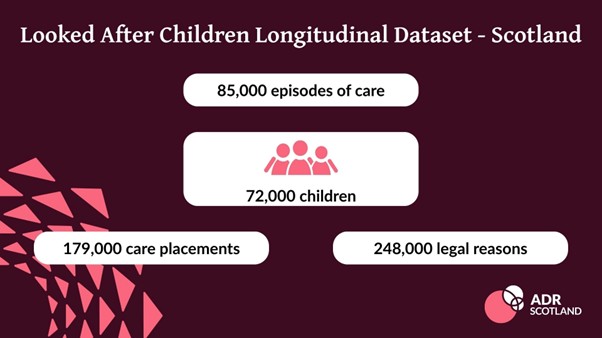
This flagship dataset includes information on approximately 72,000 looked after children in Scotland, covering 85,000 episodes of care; 179,000 placements; and 248,000 legal reasons.
| Timeframe | 2008/09 – 2023/24 |
|---|---|
| Update Frequency | Next update planned for autumn 2026 (every two years thereafter) |
| Population | Children looked after by Scottish local authorities |
| Coverage | Scotland |
| Size | 72,000 children |
Examples of research questions
The dataset enables research into care journeys, placement stability and outcomes for children and young people. Example questions include:
- How do patterns of ill health or service use differ between care-experienced children and their peers?
- How do pathways out of kinship care vary across local authorities and over time?
- What factors predict re-entry into care, and how do these differ across demographic groups or areas?
- How does being looked after influence school engagement, attendance, attainment and post-16 destinations?
- What role do sibling relationships and household circumstances play in care transitions?
This list is illustrative only and intended to demonstrate the research potential of the dataset. Please see Section 5 the User Guide for further information.
Core documentation


Other supporting resources
| Resource | Description |
| Technical guide | This report documents the initial development of the Looked After Children Longitudinal Dataset – Scotland, which includes data from 2008/09 to 2018/19. It is provided as a technical reference for users who require insight into the methodology, data processing, quality checks and linkage approaches applied in the first iteration of the dataset. |
This Data Explained summarises experiences and learning from working with the first iteration of this dataset in the course of producing research into the impact of the Covid-19 pandemic on children’s care journeys in Scotland. It provides an outline of the dataset, summarising the variables available, issues within the dataset, and current processes for data access. | |
This webinar recording from October 2021 provides an overview of the dataset, examples of research use and linkage opportunities based on earlier iterations. | |
Resources from The Promise Data & Evidence Group | Established in March 2025, The Promise Data & Evidence Group have a range of resources including a longitudinal quantitative evidence review. |
Official Statistics Information | Researchers can find comparison figures and definitions used on the Scottish Government statistical collections webpage, including specifics on ‘Scotland for Children’s Social Work Statistics’. Additional annual collection documentation is also available on the ‘Scottish Exchange of Data: looked after children and care leavers’ webpage. |
Policy Briefing (Permanently Progressing Project) | The Policy Briefing produced by the Permanently Progressing project shares interesting insights into researcher's experience of the data linkage. |
Community Group | ADR Scotland is actively considering establishing a community group for this flagship. Researchers may wish to connect with the pre-existing Children’s Care and Protection Data Community on Knowledge Hub. |
| Research resources | Researchers can also visit the RDS "Information for Researchers" page. |
Research highlights
Research projects:
- Permanently Progressing? Building secure futures for children in Scotland
- Investigating health outcomes for care experienced children
- Growing up in kinship care
- Stability of patterns of care for Children in Scotland.
Research reports:
- Inequalities in dental health needs and access to dental services among looked after children in Scotland: a population data linkage study
- Infants Born into Care in Scotland (2023)
- Impact of Covid-19 on Children’s Care Journeys in Scotland (2023)
- Growing up in kinship care (2024).
These studies highlight the analytical value of Scotland’s linked administrative data for understanding care experiences and outcomes.
Policy research priorities
The dataset supports several national policy priorities, including The Promise and Keeping the Promise, GIRFEC, Additional Support for Learning, Care Leavers and Aftercare and Scotland’s National Performance Framework. It also reflects the findings of the Evidence Framework produced by the Independent Care Review, helping to address key evidence gaps and inform future policy development.
Find out more in Section 5 of the User Guide.
Accessing the data
Access is available to accredited researchers via the Scottish National Safe Haven.
Safe Researcher Training accreditation
Researchers will need to have completed the Safe Researcher Training (SRT) course delivered by either the Office for National Statistics (ONS) or UK Data Service. This course fulfils the information governance training requirement to access this dataset via the National Records of Scotland (NRS) and Scottish Government Data Access Panel.
Researchers seeking accreditation may be interested to know that the SRT course also forms part of the process to gain Scottish Longitudinal Study Approved Researcher Status and is part of the procedure for gaining both full and provisional accredited researcher status under the Digital Economy Act (DEA).
Please visit the ONS supporting webpage or the UK Data Service webpage for guidance on SRT training and how to apply for accreditation.
Application process
Applications to use the dataset must be submitted through the Scottish Government and NRS Data Access Panel. Details on how to apply and the application form is available on the Scottish Government’s ‘request our data’ webpage.
For support, contact SPBPP@gov.scot.
Additional guidance is available via Research Data Scotland.
“This significantly enhances the research potential of statistical data on children with experience of care. By making available anonymised individual-level data, academic research is possible exploring young people’s journey through the care system. Crucially, the potential to link to other datasets means that analysis of the experiences and outcomes of care-experienced people can be better understood, and this can inform future policy development.”
Find out more
More information about the dataset and potential linkages can be found via:
You can also contact the ADR Scotland team at ADRScotland@gov.scot.