
How can research support real world impact? Reflections from the British Society for Population Studies Conference workshop
Categories: Blogs, ADR Scotland, ADR UK Partnership
29 September 2026
Making a real-world impact is a major ambition for researchers using administrative data – but in reality, this often comes with some challenges. In this blog, ADR UK and ADR Scotland teams share some key insights from their experience delivering a workshop for researchers on influencing policy.
This month ADR UK and ADR Scotland jointly presented at the British Society for Population Studies Conference at the University of Kent, Canterbury. The conference brought together the international population statistics and data science community to exchange knowledge.
We delivered a joint interactive workshop which examined how to deliver impact, titled ‘Influencing policy with administrative data: Turning research into real-world impact.’
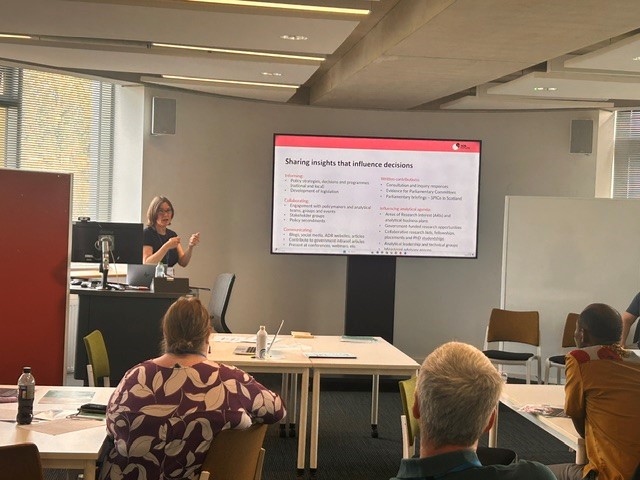
Session host Dr Bogusia Wojciechowska, Senior Research Manager for Training and Capacity Building at ADR UK reflected:
“I had the pleasure of chairing the session which aimed to promote practical learning and thought-provoking discussion around how administrative data drives policy and practice.
“The morning began with my overview of ADR UK, its data, research and exploration of who was in the room – it was a diverse group of administrative data users from Sweden to Canada to India. This made for interesting discussions throughout the session, with a stakeholder mapping tree exercise in particular raising lots of interesting themes, such as communicating with policy makers in accessible ways.”
Key learnings
Delving into the theme of delivering real-world impact, one of our wonderful ADR UK Research Fellows, Dr Justin Yang gave a reflective account of his fellowship. One of his key learnings was around the importance of considering policy implications at an early stage of the project:
“Academics can quite easily conflate policy relevance with policy influence. We ask an important question, analyse it rigorously and publish it, and assume we have done the impact part. But there is quite a lot between those two things.
“Influence depends on understanding the decision context, having relationships with the right people, timing, and producing evidence in forms that somebody can actually use”.
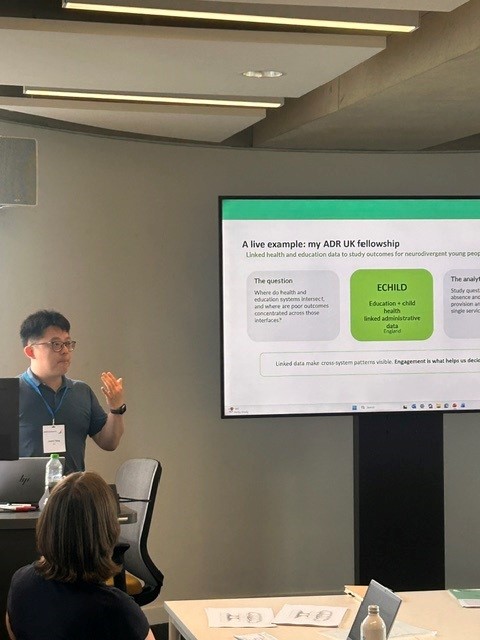
Justin noted that realistically, policy windows open and close; personnel move; and evidence competes with political priorities, resources, existing programmes and other evidence. As a result, attribution is messy.
However, researchers can influence the network around the research, by developing relationships which enable a greater chance of the evidence being used. So, he suggested that we should measure the potential for impact not only by asking ‘What output am I producing?’ but also asking ‘What relationships am I building?’
Practical tools
Sarah Thomson and Dr Anja-Maaike Green (Scottish Government) from ADR Scotland’s Engagement and Impact Team explored some of the practical tools and mechanisms available to researchers that can support relationship building and delivering impact.
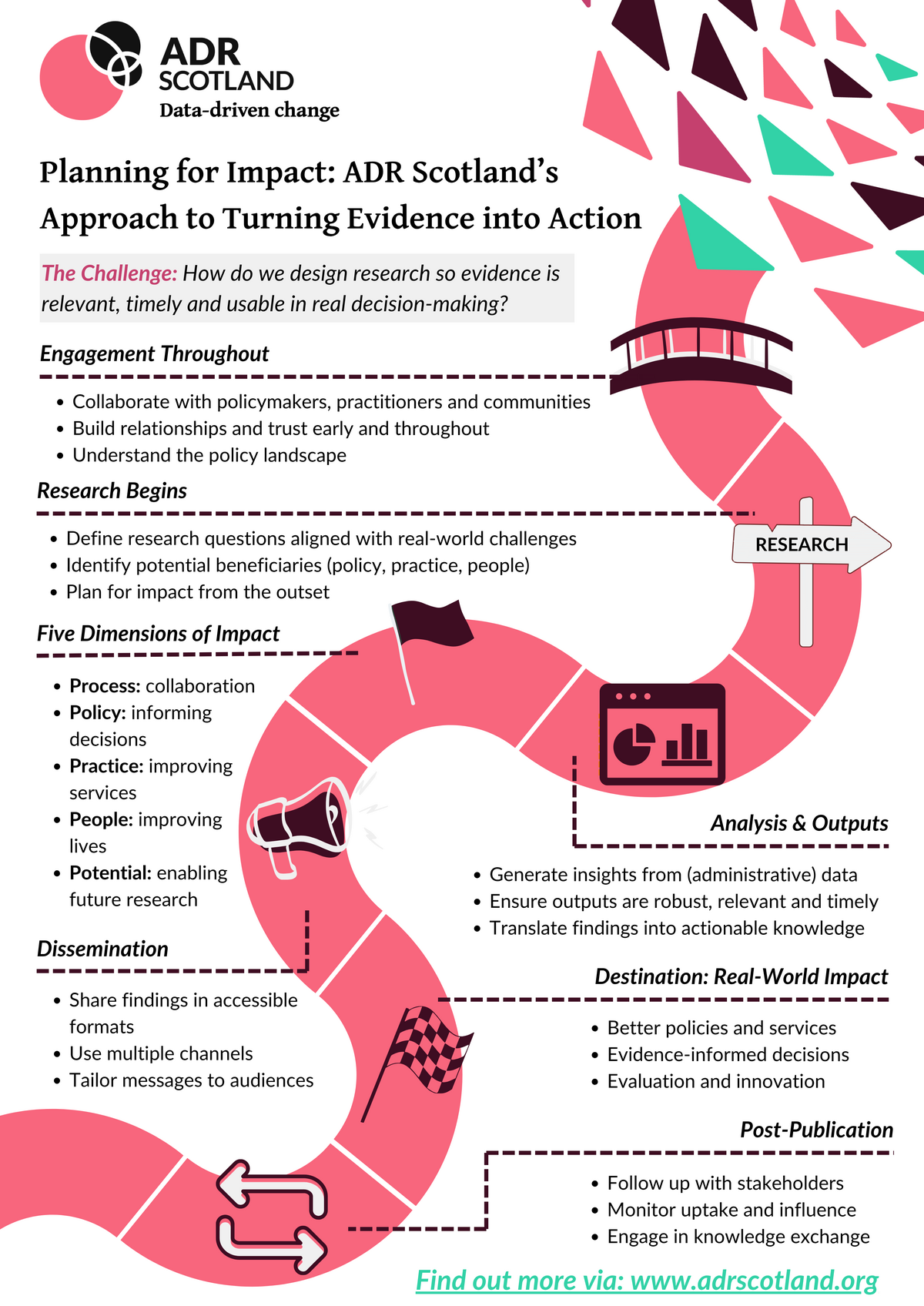
“We had the pleasure of presenting a range of practical tools that can support effective research impact. A key message centred around planning an impact pathway from before research begins to sometime after the project is completed.
“As part of this workshop, we discussed how to engage with government and the types of accessible outputs that might appeal to policymakers. We were delighted to hear positive feedback on our new Policy Brief publications – have a look for yourself! We are always interested in speaking to researchers, government and wider experts with an interest in using administrative data in Scotland so please do get in touch.”
If you’re interested in learning more about ADR UK and our national partnerships, our datasets, or upcoming funding opportunities, please sign up to our mailing list.
