
Data First: An exploration of data-driven revelations
Categories: Data linkage programmes, Blogs, Events, Datasets, Conferences, ADR England, ADR Wales, YDG Cymru, Office for National Statistics, ADR UK Partnership, Crime & justice, Social mobility & inclusion
5 August 2025
This blog is by Nisha da Silva, keynote speaker at the ADR UK Conference 2025 and contributor to the Ministry of Justice’s Data First programme. She explores how linked data reveals key insights into justice system journeys and how these findings are shaping policy, research, and technology.
In the rapidly evolving landscape of the digital age, the phrase “data first” has become a guiding principle for organisations striving to harness the power of information. With support from ADR UK, the Ministry of Justice’s Data First programme has set the trend for how government should work across boundaries with the academic community to collect, link, and analyse data to power decision-making in public policy.
Let me illustrate this with a story…
Introducing John
John was born in one of the top three most deprived areas in England. As a child, John was taken into care following a family public law case. Life wasn’t easy. In school, he was identified as having special educational needs and struggled with maths and English, though he just about reached level 4 in Key Stage 2 in both subjects.
In his late teens, he was permanently excluded from school, and within a few years, was arrested for a serious violent offence. John appeared in the magistrates’ court, and due to the seriousness of the charge, his case was referred to the Crown Court. He was tried before a jury and sentenced to 18 months in prison.
While in custody, John was assessed to identify his risks and needs. He was found to have multiple needs related to mental health and substance misuse. The category C prison he was placed in provided treatment for alcohol and drug misuse as well as mental health support. He also enrolled in a construction NVQ (National Vocational Qualification) course.
After serving half of his sentence, John was released on licence with a tag, subject to electronic monitoring. However, after a few months, John missed several rent payments and his landlord filed a claim for possession of his home. John is now back in the justice system.
Tracking John’s journey

This powerful narrative of John's life journey can be tracked through administrative data, linked via the Data First programme across the justice system and the Department for Education. Without linked data, we wouldn't be able to see how John’s experiences evolved over time or how his interactions with various public services contributed to where he is today.
That’s why we believe in linking administrative data and collaborating with the wider research community - to understand system-wide implications for those who interact with our public services.
The Ministry of Justice's Data First programme has linked a wide range of administrative datasets (see below). It also developed Splink, an open-source software for large-scale data linkage. Splink is faster and more accurate than other free tools, has saved public money, and has been downloaded more than 12 million times globally.
Data First datasets
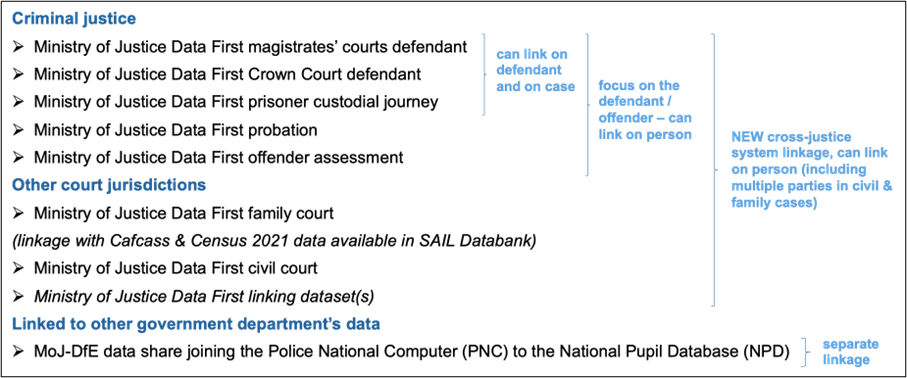
Researchers can access these datasets through secure platforms like the Office for National Statistics Secure Research Service and SAIL (Secure Anonymised Information Linkage) Databank. Synthetic data is also available via the UK Data Service to support the development and testing of research projects.
Valuable insights
Data First datasets provide a broad range of valuable insights, including:
- User journeys: understanding the pathways individuals take through the justice system, from initial contact to final outcomes
- Reoffending rates: analysing how often individuals reoffend after release or probation
- Effectiveness of interventions: evaluating the impact of rehabilitation programmes on reducing reoffending
- Demographic analysis: identifying trends and disparities in outcomes by age, gender, ethnicity, and more
- Policy impact: assessing the outcomes of reforms and policy changes
- Resource allocation: informing how best to direct public resources for greater efficiency and impact.
The impact of Data First
These insights help policymakers, researchers, and practitioners make data-informed decisions to improve fairness and effectiveness in the justice system. Some notable policy impacts include:
- Reducing reoffending: analysis has informed targeted rehabilitation programmes shown to reduce reoffending among specific groups
- Youth justice: insights into young people’s pathways have shaped early intervention and diversion strategies
- Sentencing reforms: data on outcomes has supported calls for fairer and more consistent sentencing
- Probation services: evaluations have led to improved supervision and reintegration support
- Resource allocation: analysis of court and prison data has guided decisions about where to direct limited resources
Looking ahead to ADR UK Conference 2025
In my keynote, I’ll offer an in-depth look into Data First’s journey over the past four and a half years – highlighting how, through collaboration with ADR UK and the research community, we’ve driven both technological innovation and meaningful policy transformation.
I’m looking forward to joining the ADR UK Conference 2025, connecting with fellow researchers and practitioners, and exploring how we can continue using data to build a fairer, more effective justice system together.
Join us at the pre-conference workshops
We’d like to remind you that the pre-conference workshops will be held on Tuesday 16th September, the day before the main conference. These workshops offer a fantastic opportunity to deepen your skills, network with peers, and get even more out of your conference experience.
If you’d like to attend, please purchase your ticket.