
International Women’s Day 2026: Women using data to improve lives across the UK
8 March 2026
To mark this year’s International Women's Day, ADR UK is spotlighting women working across our partnership who are using data to better understand society and improve people’s lives.
Administrative data research brings together data from across government and public services to answer complex questions about how policies affect people and communities. Behind this work are researchers, analysts and programme teams across the UK who help unlock the potential of this data for the public good.
From doctoral researchers analysing pension inequalities, to data scientists exploring the links between environment and health, to the teams supporting the infrastructure that makes research possible — women are playing a vital role in shaping the future of data-driven research.
We asked colleagues and researchers across the four nations to share how they got into working with data, what inspires them about their work, and their advice for others interested in this field.

Dr Emma Gordon – Director, ADR UK
I’m the Director of ADR UK at ESRC. My role is to oversee the programme, providing strategic leadership and working with major government departments to ensure we have a coherent UK-wide system that enables researchers to access administrative data securely and use it for the public good.
Discover Emma’s journey into data and her vision for linked data research
How did you get into working with data?
Well, this is a bit of a long story. At school, I have to say I was pretty rubbish at maths. But then all the way through university and doing my PhD and Master's, I kept being drawn into analysing data because it's just really, really inherently interesting. Once I got over my complete aversion of maths and actually got into how to statistically analyse the data, then basically, the world's your oyster.
As an academic, I did a postdoc working on the Avon longitudinal study of parents and children and that was looking at developmental and physical impairments in that cohort. And from there I worked in ONS as Head of Health Analysis.
And from there going on to more cross-cutting government roles until I became the director of the ADR UK programme, where I feel really really inspired to do my job because every day I feel like I'm doing something that is genuinely for the public good and at a huge scale. It's absolutely brilliant.
What inspires you about your job?
So what particularly inspires me about my job is being able to give researchers access to administrative data is so much better than just relying on survey data alone. With administrative data, it's every single person that touches a system or service that government is running. It allows us to go into so much more detail about really minoritised groups in a way that just was never possible before, just relying on survey data.
What’s your favourite data stat or piece of research, and why?
As I said, we're really being able to dig down into some great detail about minoritised groups. We're starting to understand now much more about the risk factors for women who experience domestic abuse. Some fantastic research from our colleagues in ADR Wales has really uncovered that these triggers and insights into people's lives are available up to three years before somebody might be involved in a public protection notification to prevent domestic abuse and violence. And if those triggers can be found in the data earlier, then maybe we can help these women earlier as well. The more we can target these services to support them, then the better their life outcomes are going to be and the better for society.
What’s the most pressing issue data can help solve?
I think for me the most pressing issues that data can help solve is really drilling down to look at where the pinch points are in people's lives. And some really interesting work done in New Zealand - and the ex-prime minister of New Zealand talks about this very eloquently, Bill English - that if systems and services are only ever looking at the average experience, you're always going to miss the people at the tail end. It won't just be one system of services that they're caught up in and can't find a way out or can't find the right level of support. It's probably two, three, four, five, six services that they're all struggling with - whether it's education, being a patient, being a prisoner, being a pensioner. All of these things interact. And if these services aren't able to talk to each other, or at least aren't able to share insights about who might be the most vulnerable and fixing the system for those people, then we're never going to be able to improve systems and services. But we could genuinely improve people's lives for the greater good - not just for themselves, but wider society as well.
What top tips do you have for anyone looking to work in data and research?
This is a really, really interesting space to be in at the moment, because all of these linked population level datasets are now available to researchers in a way that just was never possible before. The sky's the limit really in terms of the research questions that can be answered because we're adding more and more linked datasets across our themes all the time, and we've put a huge amount of effort in right across all four UK nations into training and capacity building, because we absolutely recognise that for researchers it's quite a hurdle to get over - to learn not just what's in these datasets but how to analyse them because they're so massive and complex. Take every opportunity to take up these offers of learning.

Yifan Ge – PhD student, University of Southampton
I am a third-year PhD student in the Department of Gerontology at the University of Southampton, and a member of the first cohort of 22 PhD students funded by ADR UK (and the South Coast Doctoral Training Partnership).
Learn about Yifan’s research on pension reform and inequalities
How did you get into working with data?
I completed my master’s degree in economics, and while drafting my dissertation I undertook my first data analysis project based on large scale datasets, examining the health impacts of increases in the state pension age in China. This experience showed me the power of data to investigate policy impacts and reveal inequalities across populations. As a result, I decided to pursue a PhD focused on data analysis.
What’s your favourite data stat or piece of research, and why?
There is no doubt that my favourite research is my PhD project, which looks at how increases in the state pension age have affected women in different ways and who has been most negatively impacted, particularly those born in the 1950s. Beyond the issue of limited information about pension changes, the data show how inequalities such as motherhood penalties and the gender pay gap build up over the life course.
I hope my work can help policymakers respond more fairly to the concerns raised by WASPI (Women Against State Pension Inequality) and improve communication for the women most affected. I also hope it encourages younger women to think earlier about their financial security in later life. As a young woman myself, knowing that my work could raise women’s awareness of pensions or pension reform policy, and provide evidence to help protect their financial security in later life is what motivates me to keep going.
What’s the most pressing issue data can help solve?
From my perspective, one of the most important roles of data is to make the real-life impacts of policy visible. For example, by analysing how pension reforms affect women’s retirement security across different subgroups, we can better understand which groups are at risk and design more targeted support. Moreover, using administrative data supported by ADR UK allows findings to be generalised to the wider population and helps overcome some of the limitations of survey datasets, informing policies that serve the public interest.
What top tips do you have for anyone looking to work in data and research?
For anyone looking to work in data and research, I’d say stay curious and always keep sight of the real world behind the numbers. Developing strong analytical skills is important, but it’s equally important to ask meaningful questions and understand how research can shape society.

Samantha Livingstone – Project Administrator, ADR Northern Ireland
I’m a Project Administrator at Administrative Data Research Centre Northern Ireland (ADRC NI, part of ADR Northern Ireland), based at Queen’s University Belfast. I’ve been part of the team since the beginning in 2014.
Meet Samantha and the role she plays supporting data research
How did you get into working in this sector?
Before joining ADR NI, I previously worked on a smaller 2-year EU funded research project at Queen's University , which I enjoyed, so when this post came up, I jumped at the opportunity to work on a significantly larger research project - because I love a challenge!
Over the years I’ve watched ADRC NI evolve and grow to what it is today. My role has involved everything from untangling logistics to keeping researchers calm, caffeinated, and vaguely organised. I like to think of myself as the unofficial glue holding the place together - the friendly kind, not the stuff that ruins your sleeves.
What inspires you about your job?
What inspires me most is knowing I get to continue this adventure for another five years. Being part of ADRC NI is not just a job; it’s a community I care about, a team that keeps me laughing, and a project I’m genuinely proud to support.
What’s your favourite data stat or piece of research, and why?
My favourite piece of work relates to children known to social services and explores predictors and positive life trajectories, undertaken by Dr Sarah McKenna. It’s particularly meaningful because it involves collaboration with young people from a local Northern Irish charity, Voice of Young People in Care (VOYPIC). It's my favourite piece of research as it is directly relatable to a specific sector in society - exploring real problems experienced by real people.
What’s the most pressing issue data can help solve?
For me, some of the most pressing issues data can help us understand are poverty and homelessness. Data allows us to better understand the scale of these challenges and identify where support is needed most.
What top tips do you have for anyone looking to work in your area?
My top tip for anyone looking to work in this area is that you need to have patience and resilience. Progress takes time and the road to success is often a long and bumpy one!
So here’s to International Women’s Day - and to all the women quietly keeping things running, one spreadsheet, email, and crisis-averted-at-the-last-minute at a time.

Finola Ferry – Senior Research Fellow, Ulster University
I’m a Senior Research Fellow at Ulster University and have been working with ADRC NI since 2015. I’m married to Kevin, have three gorgeous girls, and a proud Derry girl.
Read Finola’s perspective on data, job quality and economic growth
How did you get into working with data?
I’d say I’ve always had a natural tendency for quantitative reasoning. After my undergraduate degree in Economics and Business Economics, I worked as an assistant Statistician for the Northern Ireland Statistics and Research Agency (NISRA), analysing benefits data. I joined Ulster as a Researcher in 2006. The majority of my work focused on analysis of large complex population surveys and subsequently linked administrative data.
What inspires you about your job?
The people I work with. During my 20 years at Ulster, I have been very fortunate to be involved in great teams of very talented people who have encouraged me to collaborate with diverse groups of researchers. I have great mentors and colleagues in ADRC NI, who I’m often in awe of and have learned so much from.
What’s your favourite data stat or piece of research, and why?
Increasing women's participation in high-quality jobs and leadership roles significantly boosts national productivity and GDP. I really like this research theme, as it recognises not only the role of workforce gender equality in driving productivity and innovation, but focuses on the key issue of job quality, rather than just participation rates.
What’s the most pressing issue data can help solve?
Increasing the proportion of working-age people in good jobs – a key aim for the NI Department for the Economy. Linked administrative data offers enormous potential to inform initiatives aimed at improving job quality through enhanced understanding of the types of individuals in quality jobs; the types of businesses providing them, pathways and barriers to acquiring good quality jobs; and key outcomes associated with job quality.
What top tips do you have for anyone looking to work in your area?
Take time in getting to know your data and all its complexities – but also get to know the people and groups that your data represents. Link in with stakeholders and key interest groups who will be your experts on the ground to help you identify the most pressing issues, help you make sense of your findings, and support you in getting your findings into the hands of those that can make meaningful change.

Anja-Maaike Green – Engagement and Impact Team Lead, ADR Scotland
I am joint team leader (with my job share partner Sarah Thomson) for the Engagement and Impact Team in ADR Scotland within the Scottish Government.
Learn about Anja-Maaike’s career path and the potential of linked data
How did you get into working with data?
Looking back on it, I think I’ve had quite a varied career. I started out working in the cultural sector, then for local government and as a freelance consultant, before finally making my way into academia via a PhD and eventually into the Scottish Government as a social researcher. One of the real advantages of working in government is that you can move between research and policy professions, and the posts I have enjoyed most incorporate both evidence and policy understanding.
What inspires you about your job?
One of the things I enjoy about working in government is that you can move post every 2-3 years and even switch between research and policy professions. It’s a really dynamic environment and you get to meet lots of different people working in such diverse areas.
What’s the most pressing issue data can help us solve?
We work with administrative data and in many ways we are only just scratching the surface of what linked data is capable of revealing. Our team is focused on bringing academics alongside Scottish Government analysts and policy people to identify where the policy need lies, and how to bring data together to help address these pressing challenges. It’s really exciting as there is so much potential in the data, and there is real momentum behind our collective efforts to bring this forward into the policy space more effectively.
What top tips do you have for anyone looking to work in data and research?
Obviously everyone has to follow their own path, but from my experience it was helpful to look beyond the usual points of progression to see the potential that lies in other sectors such as local government, voluntary/community, and private sectors. Not all research happens within an academic or government context and it can also be rewarding to broaden out the focus of your research and to think about how you can do other kinds of research such as multi-method, rapid response work or evaluation. I’ve tried to be flexible and open to different opportunities to keep things fresh and interesting.
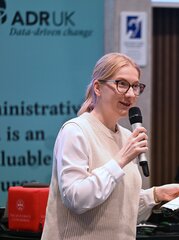
Silvia Behrens – Research Associate, University of Glasgow
I’m a Research Associate at the University of Glasgow. At the Scottish Centre for Administrative Data Research (SCADR, part of ADR Scotland), I work with the team on educational inequalities. For the project, we analyse education data linked to health data and the census. Our analysis aims to identify inequalities and produce findings that can help inform better policies and guidelines on issues such as school exclusions, non-attendance and access to additional support for learning. Outside of work, I am a language enthusiast (currently learning Japanese) and like to do embroidery and crocheting.
Explore Silvia’s work on educational inequalities in Scotland
How did you get into working with data?
For my PhD research, I designed and ran my own survey on young people’s political participation in the UK. In other projects, I also worked with secondary survey data, for example the UK Household Longitudinal Study. I enjoy coding, so over the years, I’ve learnt to do analysis in SPSS, R and Stata. Moving from survey data to administrative data was a learning process, but having had that background in survey data analysis was very valuable.
What inspires you about your job?
I like that my work can inform meaningful and positive change for pupils in Scotland. Education is a very important resource and looking at patterns of inequalities is crucial to understanding where to address structural inequalities. Being able to do so using administrative data is a privilege. I am also very lucky to be part of a great team and to have supportive colleagues at SCADR.
What’s your favourite data stat or piece of research, and why?
Related to my area of research, the impact of socioeconomic position cannot be overstated. Pupils who have ever been registered for free school meals are twice as likely to be absent from school for 10% or more of the academic year.
Personally, I am interested in what is called ‘Data Feminism’, which introduces the idea that data is shaped by social inequalities and power imbalances. The gendered dimension of data is one aspect, though the approach focuses on intersectionality in data collection and modelling results. This is especially important for measurement which may be influenced by underlying inequalities related to gender, class or ethnicity.
What’s the most pressing issue data can help us solve?
In the context of my work, I would say addressing societal inequalities as early as possible by improving children’s access to special educational support and reducing the gaps in attendance, exclusion and attainment by socioeconomic position.
The work we do at SCADR can contribute to this but can only be part of wider research and policy efforts. We have also seen some gender gaps in exclusions (with boys being more likely to be excluded) and absence (with girls being more absent after starting secondary school) which warrants further research into how to address this and why that may be.
What top tips do you have for anyone looking to work in data and research?
Be curious and engage in as much learning as possible! It is okay to be overwhelmed when starting with a new dataset and administrative data can be quite messy and behave surprisingly. ADR UK regularly announces fellowships to work on specific administrative datasets. There are also many interesting jobs in academia, third sector organisations and government or policy bodies that use a wide range of data.

Dr Dora Pouliou – Senior Data Scientist, ADR Wales
I'm a Senior Data Scientist working with ADR Wales and Swansea University, where I use large-scale, linked population and survey cohort data to understand how social, economic and environmental factors shape health outcomes.
Watch Dora’s video and learn about her research on health and data
How did you get into working with data?
I originally trained in health geography and social epidemiology, which naturally led me to working with population data to explore socio-economic and environmental inequalities. As I became more involved in large administrative datasets, I saw how powerful linked data can be for answering complex questions about gender, deprivation and health.
What inspires you about your job?
What really inspires me is that data isn’t just numbers — it’s a way to shine a light on real inequities and help improve policy and practice. Knowing that robust data analysis can influence decisions affecting children’s health, neighbourhood environments or mental wellbeing keeps me passionate about what I do.
What’s your favourite data stat or piece of research, and why?
One of my favourite stats is that globally only around 22% of AI and data science professionals are women, which highlights ongoing gender imbalance in the field and the importance of diversity in working with data.
Personally, during a recent project on active travel to school in Wales, we observed that boys were more likely to actively travel to school than girls, showing how linked population, survey and geospatial data could help us in designing targeted interventions to encourage active travel, particularly among specific population sub-groups.
What’s the most pressing issue data can help us solve?
One important challenge is understanding how health and wellbeing evolve over the life course and across different social contexts. Linked data allows us to follow populations over time and identify where targeted support is mostly needed. The more effectively we use these data resources, the more informed our policies can be.
What top tips do you have for anyone looking to work in data and research?
Build a strong foundation in quantitative skills but also stay curious about the real-world problems behind the numbers. It’s important to be comfortable working with different types of data — both administrative data, which gives scale and longitudinal insight, and survey data, which often provides richer contextual detail. And finally, be open to interdisciplinary collaboration; some of the most meaningful research comes from combining methods, perspectives and data sources.