
Why are some pupils persistently absent from school? We asked young people for their views
Categories: Research using linked data, Blogs, Public engagement, Research findings, ADR UK Research Fellows, ADR England, Office for National Statistics, Children, young people & education, Health & wellbeing
20 April 2026
ADR UK Research Fellow Hanna Creese has been using the Education and Child Health Insights from Linked Data (ECHILD) dataset to explore how health and socioeconomic factors relate to school attendance. But data alone rarely tells the whole story. So Hanna turned to the experts themselves: young people with lived experience of struggling to attend school.
When we talk about persistent school absence, it’s easy to get lost in the statistics. Behind every number, though, is a young person with their own story.
Why young people’s voices matter
After the Covid-19 pandemic, many expected school attendance to return to pre-pandemic levels. Yet this has not happened for everyone, and persistent absence remains a major concern, particularly for disadvantaged pupils.
Research and policy discussions often ask what is happening here. I wanted to understand the why and hear this directly from young people themselves.
That’s why we worked with a group of young people aged 14–16 from Step Out Mentoring in London, all of whom had experience of struggling to attend school. We posed a simple question: why might children and young people find it hard to go to school?
What they told us
Across two workshops, we used creative activities to open up the conversation. From playdough icebreakers to writing ideas on Jenga blocks, the aim was to create a space where everyone felt comfortable sharing their views and experiences.
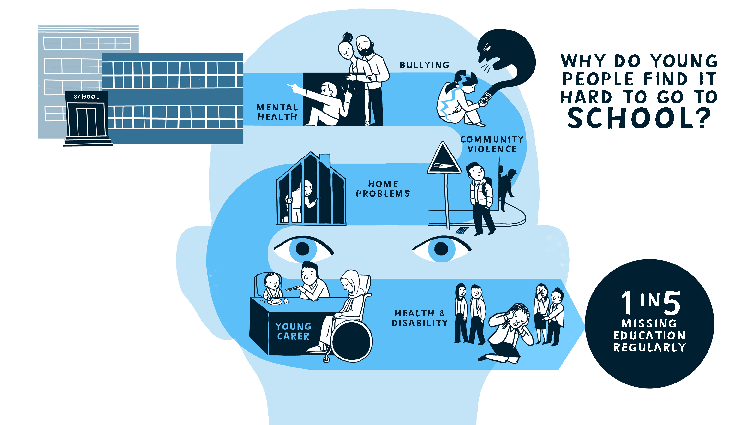
Six key themes emerged:
- Mental health
- Bullying
- Community violence
- Challenges at home
- Caring responsibilities
- Physical health and disability
Rather than stopping at discussion, we worked with the group to turn their insights into an animation. The young people helped shape the storyboard, and each chose a theme to record voiceovers describing their experiences. Their words are woven into the final film. You can watch it below.
We also developed supporting materials, including visual assets that can be used in schools to spark discussion.
What this adds to data-driven research
Administrative data helps us see patterns across large populations. But it cannot fully capture lived experience.
Public engagement adds that missing layer, helping us interpret findings, challenge assumptions, and design more meaningful interventions.
For me, this work reinforced the idea that data and lived experience should not be seen in isolation. They are complementary, and both are needed if we want a fuller understanding of school absence.
What happens next?
The animation is now being shared with schools as a discussion tool. The hope is that it will help teachers and students talk more openly about attendance and the barriers young people face.
More broadly, this project highlights the importance of involving young people in conversations about policies that affect them.
