
Youth migration and geographical inequalities
Categories: Research using linked data, Blogs, Research findings, ADR UK Research Fellows, ADR England, Office for National Statistics, Children, young people & education, Social mobility & inclusion, Employment & the economy
17 March 2026
In this blog, ADR UK Research Fellow, Xiaowei Xu, shares her reflections on her project on youth migration using Longitudinal Education Outcomes (LEO) data.
My motivation for exploring migration
I became interested in internal migration when working on the geography chapter of the Institute for Fiscal Studies Deaton Review of Inequalities with Henry Overman. Our starting point was the literature that splits out spatial wage inequalities into ‘people’ and ‘place’ effects. This highlighted the importance of ‘sorting’: the tendency of people with high earnings potential to cluster in certain places. Across a number of countries, most of the differences in average wages across places can be accounted for by sorting.
My initial – far too simplistic – reading of this was that “place doesn’t matter”: geographical inequalities simply reflect the distribution of skills. However, I soon came to a more nuanced understanding, recognising that the distribution of skills is an equilibrium outcome. If high-skilled people are clustered because they move to places that offer opportunities, then the distinction between people and place effects isn’t particularly meaningful, at least for understanding the sources of spatial disparities.
In subsequent work with coauthors at the Institute for Fiscal Studies, we found that migration up to age 27 does indeed increase the concentration of skills in England, measured by the share of people with a degree. However, this does not directly address the question of whether people move to opportunity. Further, several commentators noted that 27 is still quite young, and migration after this age (as people settle down) could reverse some of this initial sorting. I wanted to address these two questions in this paper, produced as part of my ADR UK Fellowship using the Longitudinal Education Outcomes (LEO) dataset.
How young workers move – and why it matters
I found that young workers in England – especially graduates – are highly mobile across local labour markets (Travel-to-Work Areas) at the start of their careers. One in five graduates live outside their hometown by age 27. In this early phase, graduates move away from places with weaker economic opportunities, towards cities offering better prospects.
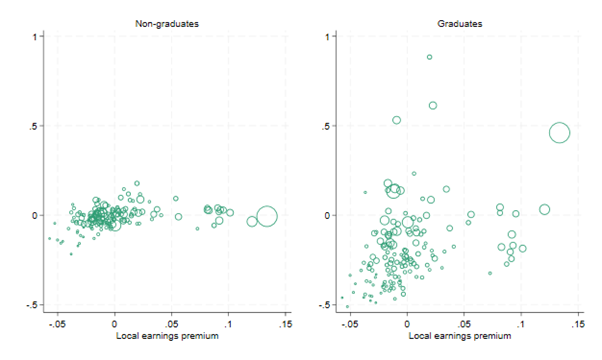
This is shown in Figure 1, which plots the net migration rates in each area against the local earnings premium – how much a given individual can expect to earn there, relative to what they can expect to earn in the average area. There is a clear positive correlation for graduates, but not non-graduates. The size of the dots represents population size. At any given level of earnings premium, larger cities experience higher net migration of graduates.
Figure 1. Correlation between net migration rates and local earnings premiums, age 16 to 27
Source: Longitudinal Educational Outcomes, 2012 – 2019.
Notes: Net migration rates refer to the number of in-migrants minus out-migrants at age 27, relative to the number of residents at age 16. Size of bubbles denotes the number of residents at age 1. Local earnings premia are estimated at the firm level and normalised to the unweighted average across all TTWAs (e.g. 5% implies a given individual would expect to earn 5% more there than in the average area).
Young workers continue to be highly mobile between age 27 and 32, but patterns of mobility are very different. Graduates no longer flock to high-paying cities, and net graduate migration to London at this stage is close to zero, with large outflows balancing out large inflows.
I was surprised to find that this does not, however, undo the sorting from earlier periods. Though on reflection, perhaps this should not have been surprising. Return migration is negatively selected: low-skilled migrants are more likely to return to their hometowns. And whilst many people move away from London in their late 20s and early 30s, those who leave tend to go to already-prosperous areas in the South East, rather than to deprived places.
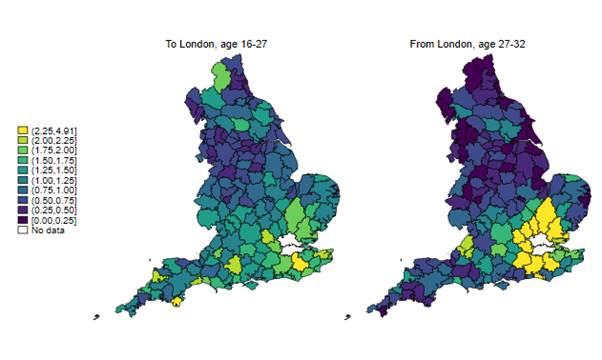
The scale of onward moves from London was really striking. A third (34%) of those who moved to London by age 27 leave the capital by age 32, 42% of whom move to an area that directly borders London. In this way, London fundamentally redistributes skills across the country. It draws in skilled workers from all over the country at the start of their careers, who subsequently settle down further out in South East England (Figure 2).
Figure 2. Origins of movers to London by age 27 (left) and destinations of onward movers from London age 27–32 (right)
Source: Longitudinal Educational Outcomes, 2012 – 2019.
Notes: This shows the location quotient – the number of migrants to (from) London in an area as a share of the population of that area at the start of the period, scaled by the total number of migrants as a share of the total population. A value of 1 implies that an area has as many movers to (from) London, as you would expect if movers were randomly distributed.
Another surprising finding was that rates of migration have increased in recent cohorts, especially among graduates. The literature on internal migration is dominated by studies from the US, where a decades-long decline in migration is a source of concern, linked to falling labour market dynamism. In contrast, I find that in England, graduates born in 1997 are 8 percentage points more likely to have moved than otherwise similar graduates born in 1986. This suggests that migration could be playing an increasing role in widening geographical inequalities.
Reflections on the project
I really enjoyed working on this project. It fleshed out my understanding of geographical inequalities in England and raised some interesting questions for future research. On the former, I think migration is an important part of why geographical inequalities are so persistent. Traditional spatial models suggest we should expect economic outcomes across places to converge over time, as capital moves into, and labour moves out of, regions hit by negative shocks. The LEO data shows that labour does indeed flow from low- to high-performing places, but it’s the high-skilled people who leave, which means that labour mobility may exacerbate (rather than alleviate) economic differences between places.
The project enabled me to build links to other researchers working on complementary topics and appreciate how the migration story fits into the bigger picture. My paper formed part of a symposium issue of Fiscal Studies on geographical inequalities, which also included a paper by Daams et al. on capital flows and a paper by Carneiro et al. on social mobility. We drew out the links between these papers in a comment piece and organised an event to discuss policy implications.
I found the work on capital flows particularly interesting – it isn’t something I’ve thought about before, but is obviously another piece of the persistence puzzle. The link between migration and social mobility is something I would like to explore further, especially if information on parental incomes is added to the LEO dataset.
Disclaimer
This work was produced using administrative data accessed through the ONS Secure Research Service. The use of the data in this work does not imply the endorsement of the ONS or data owners in relation to the interpretation or analysis.
This work uses research datasets which may not exactly reproduce National Statistics aggregates. National Statistics follow consistent statistical conventions over time and cannot be compared to Data First linked datasets.
