
ADR UK Training and Capacity Building Strategy 2026-31
Categories: Reports, ADR UK Partnership
16 April 2026
This strategy sets out ADR UK’s vision and approach for Training and Capacity Building (TCB) during the 2026-2031 investment phase. It aims to support ADR UK’s overall mission to improve access to and use of secure forms of administrative data for research that informs better policy and outcomes.
Executive summary
Building on the successes and lessons of the previous investment phase, this strategy outlines a collaborative, UK-wide framework for developing the skills, knowledge and support structures needed to enable researchers to work confidently and effectively with administrative data. It reflects the diverse strengths of the ADR UK partnership across England, Scotland, Wales and Northern Ireland, and responds to evolving needs identified through stakeholder engagement and survey analysis.
The strategy is structured around three core delivery pillars:
- Resources and signposting: Enhancing access to learning materials, tools and communities through platforms like the ADR UK Learning Hub and Datacise.
- Training and skills development: Offering a range of courses and experiential learning opportunities tailored to flagship datasets, research methods and public engagement.
- Support structures: Strengthening peer networks, mentoring and cohort support to foster inclusive and sustainable communities of practice.

Key goals include:
- Aligning training provision with ADR UK’s strategic objectives, including public good, data access, researcher support and public trust.
- Expanding reach across disciplines, career stages and geographic regions.
- Embedding equity, co-design and evidence-informed practice throughout delivery.
- Establishing robust mechanisms for monitoring, evaluation and continuous improvement.
Through this strategy, ADR UK aims to build a scalable and sustainable training ecosystem that empowers researchers, supports innovation and maximises the impact of administrative data research across the UK.
Background and strategic context
ADR UK’s mission is to transform the way researchers access and use the UK’s wealth of public sector data to generate insights that lead to better policy and outcomes. Training and Capacity Building (TCB) is a vital component of this mission, enabling researchers to develop the skills, confidence and support networks needed to work effectively with administrative data.
During the 2021-2026 investment phase, ADR UK tested and refined a range of approaches to TCB. These were delivered through five key routes:
- Information provision
- Signposting
- Existing ESRC-funded programmes (PhDs)
- Training courses
- Experiential learning
Appendix 1 summarises the activities we have delivered through each of these routes.
These efforts have been integral to ADR UK’s broader success, complementing the provision of research-ready data, funding for research, and communications and engagement activities. While it is difficult to attribute the impact of TCB alone, the 2024 Interim Economic Evaluation highlighted a cost-benefit ratio of 5.05, with flagship datasets (which routinely have bespoke training programmes and resources provided alongside them) valued at £42.58 million and non-flagship datasets at £1.86 million.
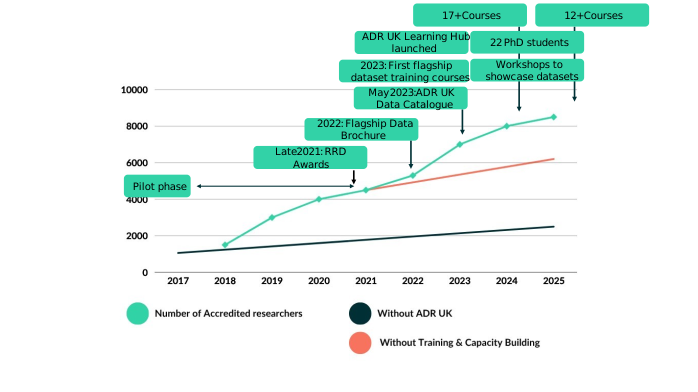
Figure 1 below shows the trajectory of accredited researchers in our trusted research environments (TREs), annotated to show TCB activities that have supported growth:
This strategy builds on those foundations, aiming to scale up and strengthen TCB provision across the UK. It draws on lessons learned, addresses identified gaps and embraces new opportunities to support researchers at all career stages and across disciplines.
The Training and Capacity Building Partnership group comprising representatives from the academic and government arms of ADR England, Scotland, Wales and Northern Ireland has co-produced this strategy and assumes shared ownership of it.
Training needs analysis
To inform the 2026-2031 investment phase, ADR UK conducted a needs analysis during 2025 using a survey to reach individuals through our networks across the partnership. The findings highlighted four key areas where researchers require further training to effectively use administrative data for research:
- Reproducibility – including the use of GitHub, developing robust code using various software packages, and adopting good practice for reproducible research.
- Public engagement – particularly developing strategies for identifying and recruiting public representatives, and having access to case studies for demonstrating successful engagement
- Making an impact – understanding effective research dissemination strategies, co-production and the use of focus groups
- Flagship datasets – navigating ethical and legal approval processes, access protocols and developing deeper knowledge of the data.
In addition to the survey, ADR UK partners provided information about their planned training provision based on demand. This is shown in Appendix 2 and worked into the following strategy.
