
Data Insight: Disability pay and employment gap variations across England and Wales
Categories: Research using linked data, Research findings, Data Insights, ADR UK Research Fellows, Policy, ADR England, ADR Wales, ADR UK Partnership, Health & wellbeing, Social mobility & inclusion, Employment & the economy
11 February 2026
This Data Insight, from ADR UK fellow Daniel Derbyshire, shares emerging findings from a research project combining data from the ASHE-Census 2011 dataset with data from the Annual Population Survey. The project explores the disability pay gap and disability employment gap across England and Wales. The insights presented here highlight how the nature and extent of labour market inequalities experienced by disabled people varies greatly across England and Wales.
Disabled people experience significant and persistent labour market inequalities compared to non-disabled people. While the disability employment gap is well understood and researched, the disability pay gap remains relatively under-researched.
This project seeks to use the ASHE-Census 2011 dataset to provide novel insights into the disability pay gap across England and Wales.
What we found
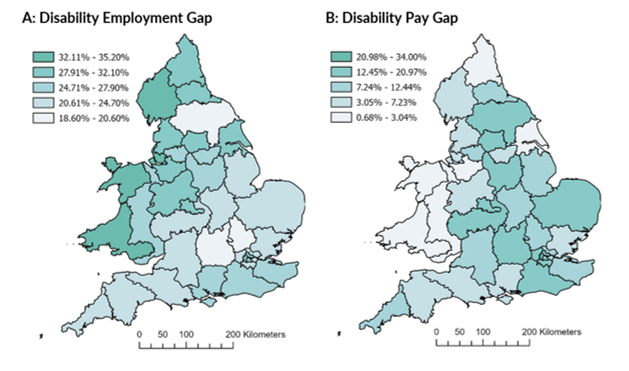
Figure 1 shows both the disability employment gap and disability pay gap across England and Wales. As can be seen, the disability employment gap is generally larger across the north of England and in Wales compared to the south of England.
Conversely, the disability pay gap tends to be larger in the south of England compared to the north of England and Wales. It therefore appears that the areas with larger disability employment gaps tend to have lower disability pay gaps, and vice versa.
Figure 1: The disability employment gap and disability pay gap across NUTS2 regions England and Wales in 2011 - for the full data findings, see table 1 in the Data Insight.
Why it matters
The aim here is not to suggest a causative link between the disability employment gap and the disability pay gap, both are structural, macro-level phenomenon and the relationship between them is mediated by a range of economic and social factors. Instead, the point is to highlight the inverse association between these two forms of inequality.
At first glance, you might look at the spatial distribution of the disability employment gap shown in these maps and conclude that disabled people face greater labour market inequalities in the north of England and Wales. However, this does not take into account that the disability pay gap tends to be smaller in these same areas. While disabled people may face greater labour market exclusion in some areas, they experience greater pay disparities in others.
What next?
This Data Insight has only mapped the disability employment gap and disability pay gap. The purpose of this project is to understand the drivers of this variation in the disability pay gap across England and Wales. One of the key factors to understand and account for is demographic differences between the populations of disabled people and non-disabled people in terms of differences in age, gender, education, occupation, etc.
