
Data Insight: Firms and earnings growth gaps by education
Categories: Research using linked data, Data Insights, ADR UK Research Fellows, ADR England, Office for National Statistics, Children, young people & education, Employment & the economy
23 February 2026
This Data Insight uses the Longitudinal Education Outcomes (LEO) dataset – England to compare the labour market trajectories of students who followed academic and vocational pathways after their GCSEs. The insights point to a substantial gap in earnings growth, with students who followed academic education routes experiencing higher earnings growth in their careers. The research highlights the role of firms in explaining and amplifying this difference.
What we found
Earnings trajectories by education
Figure 1 plots the evolution of average annual earnings of young workers who acquired academic or vocational education, as they accumulate years of experience in the labour market, separately by gender. In defining the starting line, this measure of experience considers when individuals completed their studies (often later for academic students who are more likely to progress to Higher Education) to avoid capturing students who were still in part-time student jobs. The figure reveals that academic-educated female workers benefit from higher earnings right from the start, with the gap increasing considerably as their earnings grow faster with experience than for vocational-educated females. For males, earnings are initially comparable between the two groups, but earnings growth of vocational-educated young workers is soon outpaced. After 12 years of work experience, academic-educated workers earn approximately 10 to 12 thousand pounds more than their vocational counterpart.
Figure 1: Average annual earnings by experience
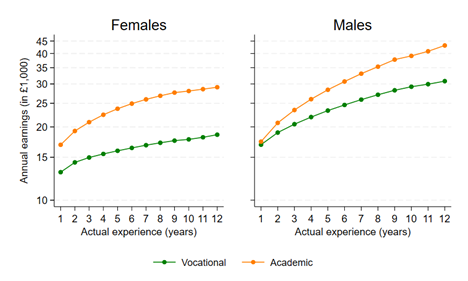
Notes: Gross annual earnings measured in 2021 prices shown in a logarithmic scale. Actual experience refers to years observed in employment (positive earnings). Source: LEO.
One limitation of this simple plot of average earnings is that it does not take into account two important aspects that could be misleading. First, to the extent that students doing A-levels and then going to university take longer until they enter work, they may enter at a better or worse time for the economy. Differences in earnings growth by education may therefore mask how fast wages are growing for everyone at different times. Second, the composition of workers with a specific level of labour market experience may change from year to year. This is because not everyone is continuously in employment for up to 12 years. This means part of the earnings growth we are looking at in Figure 1 may simply come from comparing individuals who earn more on average with individuals earning less. Luckily, we can use regression analysis to address both these potential problems.
The analysis, reported in Figure 2, confirms that the earnings patterns described above still hold. For each experience point (horizontal axis), the figure shows by how much more the earnings of academic students have grown compared to vocational students with reference to the beginning of their careers (when they only had one year of experience). For example, looking at men (right panel), we can see that after two years of employment, their earnings have grown by nearly 10% more than for vocational students. This gap keeps growing steadily for men, and by the time individuals have spent 12 years working, it is nearly 30%. For women, we see a similar pattern, but the gap seems to stabilise after nine years, when the curve flattens. Overall, our findings point to substantial differences in earnings growth between academic- and vocational-educated students, which appear early on in young workers’ careers.
Figure 2: Academic-Vocational gap in earnings growth by experience
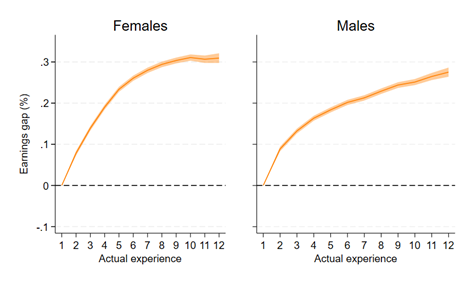
Notes: Percent difference in earnings growth between academic and vocational students (obtained from regression estimates including also individual and tax year fixed effects). Actual experience refers to years observed in employment (positive earnings). Source: LEO.
Firm sorting pattern by education
In the next part of the analysis, we studied the role played by firms in explaining the differences in earnings growth illustrated above. We start by plotting the probability of workers with different types of education being employed across different sectors. The most striking finding across genders is that academic-educated students are much more likely to be employed in ‘Professional services’ (Figure 3). They are both more likely to enter this sector as they complete their studies – more than 20% of women and nearly 30% of men are already working in professional service firms in their first year of post-education work experience – and to move later on. On the flipside, we can see that vocational-educated female workers are much more likely to be employed in ‘Education and Healthcare’ whereas male workers are more likely to be employed in ‘Manufacturing’ and ‘Trade and Logistics’.
Figure 3: Probability of working in different sectors
A. Females
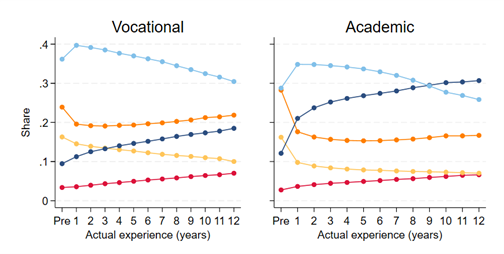
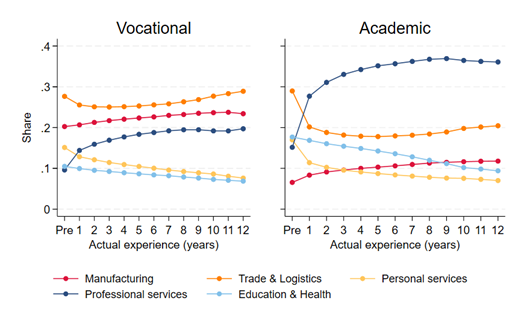
Notes: Probability of being employed in different sectors (conditional on having positive earnings) by education group and gender. Actual experience refers to years observed in employment (positive earnings). The period labelled as ‘Pre’ pools together all the tax years in which an individual was older than 18 but still observed in some type of education. Source: LEO.
These differences in employment patterns across sectors could explain why the earnings of vocational-educated young workers grow more slowly. To better gauge this, we directly looked at the two groups’ probability of being employed in firms with a higher pay premium (see definition above). Figure 4 (see full publication) shows that, within the first few years of work experience, academic-educated workers are more likely to find employment in firms that pay better on average, with the gap being especially large for women. This pattern is consistent with the analysis of sector presented above, but holds even within industrial sector. In other words, when comparing workers who are employed in the same sector, we find that academic-educated ones are more likely to be employed in higher-paying firms within that sector – though the gap is smaller.
Read the full publication to see all the findings.
Why it matters
These findings highlight how a substantial part of the earnings gap arising from different post-16 education paths can be explained by variation in opportunities across firms and differential access to them by education. Knowing this is important not only for developing a better understanding of how labour market inequalities emerge in the first place, but also for formulating policy alternatives. Over the last decades, policymakers in England have been very active in enacting reforms aimed at improving the economic prospects of vocational students. Many of these reforms remain well-intended, as they sought to address structural weaknesses of the Further Education sector in England that needed urgent tackling. However, the findings of this Data Insight offer a cautious reminder that, to a very large extent, reducing the gap in labour market outcomes between those who follow an academic path and those who follow a vocational one involves improving the latter’s access to firms with better job opportunities.
Are there any policies that could help with that? Here is where our research cannot currently provide definite answers. After all, we still need to understand why workers with a given education background are more likely to find employment in certain firms. Is it explained by workers’ preferences, dictated by firms’ hiring necessities or, more plausibly, a combination of both? Policies aiming at improving the matching process in the labour market, whether through curriculum reform or targeted interventions, can likely help, up to a point. At the same time, variation in firm quality both across and within sectors remains an intrinsic feature of the economy. Insofar as firms have different production necessities, equal access to ‘better firms’ for workers with different education backgrounds is not something that can be wished at will. Having said that, a greater role for higher level technical and vocational education and better coordination between education, skill and industrial policy, promise to expand the opportunities available for young people coming out of the vocational pathway. To what extent these policies can work should be of great research interest in the future.
