
Data Insight - Linking NMC registration data to Census 2021 for England and Wales
Categories: Data Insights: ADR Scotland, Data Insights
1 July 2026
Linking Nursing and Midwifery Council registration data to Census 2021 for England and Wales: a new data resource for health workforce research
Summary: This Data Insight describes the Nursing and Midwifery Council (NMC) Register linked to Census 2021 for England and Wales. The resource links a near-complete professional register with census measures of social, household, employment, health, disability and geographic context. It was created to support population-scale research on recruitment, retention, workforce participation, health, and inequality among nurses, midwives and nursing associates.
What we did
Alongside the Office for National Statistics and the Nursing and Midwifery Council we helped create a ‘first of its kind’ linked population data resource by combining professional registration data from the NMC register with Census 2021 records for England and Wales. The NMC register identifies people registered to practice as nurses, midwives and nursing associates. Analysis drawing on the social sciences is made possible by the linkage of Census 2021 data for those usually resident in England and Wales, with variables giving indication of sociodemographic characteristics, employment, occupation, migration, household context, health, disability and geography.
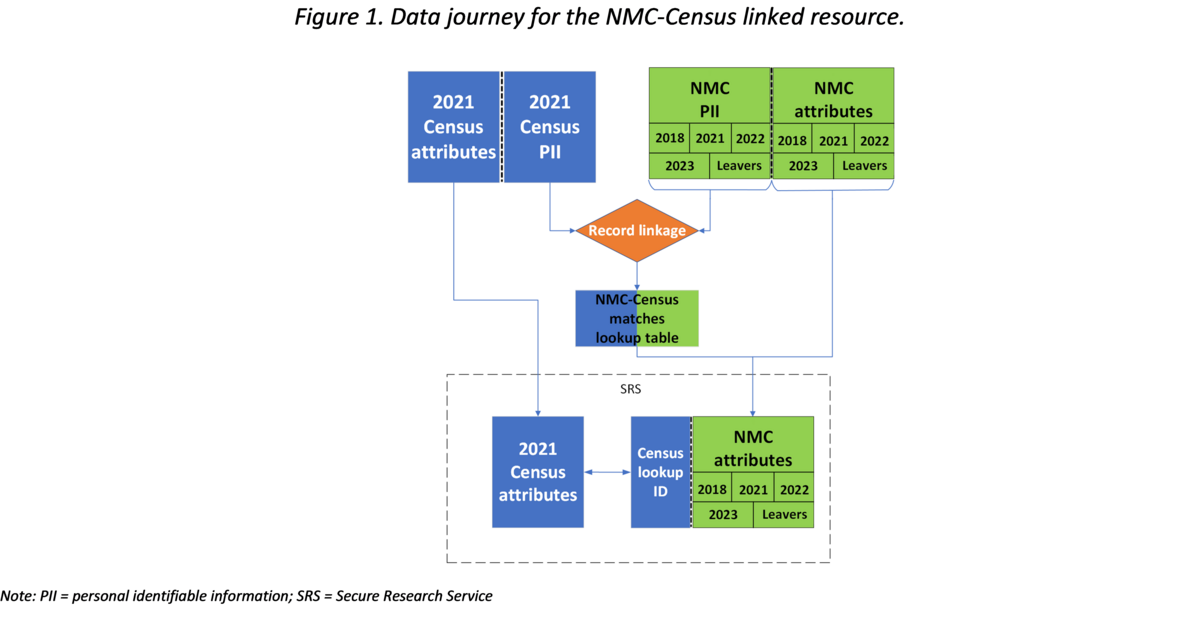
The resource brings together NMC register snapshots for 2018, 2021, 2022 and 2023, plus a leavers table covering 2018 to 2021. The 2021 Census component applies to registrant’s resident in England or Wales on Census Day, 21 March 2021. The ONS carried out the record linkage and made the de-identified linked resource available for approved research in the Secure Research Service.
Figure 1 below summarises the dataset. The Office for National Statistics created a match key between NMC and Census 2021 records. Researchers then access de-identified NMC registration attributes and Census 2021 attributes through the Secure Research Service, rather than identifiable data.
What we found
Initial checks showed that the original 2021 NMC data extract did not fully match the reported numbers from the NMC’s own register report in 2021. This was because some registrants who were actually part of the 2021 register population were not present in the original 2021 data extract, but could be identified from 2022 NMC data extract. Data quirks like this can be presented in administrative data.
Quality checks identified 6,265 additional registrants in the 2022 data extract who had registration dates on or before 31 March 2021 and were therefore part of the 2021 register population. After adding them, the rebuilt 2021 NMC data extract contained 732,835 registrants and matched the reported NMC register totals.
Of these, 614,975 registrants were living in England or Wales and were therefore eligible to be linked to Census 2021. In total, 565,680 registrants were successfully linked, creating a large secure research dataset for understanding the nursing, midwifery and nursing associate workforce.
As with any linked dataset, some eligible people could not be linked. Future checks will compare linked and unlinked registrants to understand whether this affects any specific analyses.
Table 1: NMC Linked 2021 cohort at a glance
| Linkage stage | Count |
| Rebuilt 2021 NMC register population | 732,835 |
| Registrants’ resident in England or Wales and eligible for linkage | 614,975 |
| Successfully linked to Census 2021 | 565,680 |
| On NMC register, but not linked to Census 2021 | 49,295 |
The resource is explicitly designed to support research on workforce recruitment, retention, participation and inequality. It also enables wider social science and population data science questions because it links a large professional group to detailed census measures of social and economic circumstances.
Table 2. Key components of the NMC-Census 2021 linked data resource
| Component | What it contains | Time coverage | Contribution to the resource |
| NMC register attributes | Registration type, field of nursing, training country, work setting, scope of practice and registration history | 2018, 2021, 2022, 2023 | Identifies the registered nursing, midwifery and nursing associate workforce and supports analysis of professional characteristics. |
| NMC leavers table | Information on registrants who left the NMC register | 2018-2021 | Supports research on retention, exit and movement out of professional registration. |
| Census 2021 attributes | Demographic, household, health, disability, employment, migration and geographic information | Census Day 2021 | Adds social, economic and household context not available from registration data alone. |
| Record linkage | ONS linkage between NMC registrants and Census 2021 records | 2021 linkage | Enables professional registration attributes to be analysed alongside Census 2021 characteristics. |
| Final linked analytical resource | De-identified NMC-Census data accessed in the SRS | NMC 2018-2023 linked to Census 2021 | Enables population-scale research on recruitment, retention, workforce participation, inequality and geography. |
Why it matters
The linked resource provides a basis for researchers to address a wide range of key policy relevant questions. NMC registration data describe the registered workforce, including registration type, field of nursing and registration history. When securely linked to Census 2021, these data can be analysed alongside social, economic, household, health and geographic information while protecting registrants’ confidentiality. However, the register alone cannot describe the wider social, household, labour market and geographic circumstances of registrants in detail. Census 2021 can describe the population of England and Wales in detail, but it cannot identify NMC registration status or professional registration characteristics. The linkage therefore creates analytical value that neither source can provide alone.
This matters for workforce planning because headline registration counts do not fully explain recruitment, retention or workforce participation. The linked resource allows future researchers to study registered professionals in their wider social context, including employment and occupation, migration, caring responsibilities, household circumstances, health, disability and place of residence. These are precisely the kinds of factors needed to understand why people enter, remain in, leave or move around the nursing and midwifery workforce.
The resource also has value beyond a single professional group. Large occupational datasets have historically generated wider insights into health, inequality and labour market dynamics, such as the famous Whitehall Studies (with insights on inequalities), the medics study (smoking) and the Nurses Health Studies in the United States. By linking a national professional register to census data, the NMC-Census resource provides a platform for research on workforce inequality, social stratification, migration and population health, while retaining direct relevance to nursing, midwifery and health and social care policy.
What's next?
It is for researchers to take advantage of this resource to answer key questions around the nursing and midwifery professions. Key examples include analyses of recruitment and retention, variation in workforce participation, internationally trained registrants, regional workforce distribution, leavers from the register, disability and health among registrants, and the relationship between professional registration and census-recorded employment or occupation. Importantly, these analyses can enable more holistic insights than has previously been possible by drawing on the social sciences.
Researchers can access the dataset through the Office for National Statistics Secure Research Service, subject to accreditation, project approval and statistical disclosure control. Outputs should distinguish carefully between the UK-wide NMC register, the England and Wales population eligible for Census linkage, and the final linked analytical cohort. This distinction is central to responsible interpretation of the data resource.
For more information on the NMC-Census 2021 – England and Wales flagship data resource, the pre-print can be accessed here: https://osf.io/preprints/socarxiv/zqbck_v1