
Intergenerational social mobility among UK Armed Forces service‑leavers: Evidence from the ONS Longitudinal Study
Categories: Office for National Statistics, Health & wellbeing, Impact, Potential
2 July 2026
This research used data made available via the Office for National Statistics (ONS) Secure Research Service, which is being expanded and improved with ADR UK funding.
Authors: Umair Ali and colleagues at the School of Health & Social Care and Business School, Edinburgh Napier University; ADR Scotland; King's Centre for Military Health Research and Institute of Psychiatry Psychology and Neuroscience King's College London; and University College London.
Date: June 2026
Research summary
This study provides the first population‑scale evidence on intergenerational social class mobility among UK Armed Forces veterans in England and Wales. Using the ONS Longitudinal Study, the research found a wide variation in social mobility amongst veterans, with reserve veterans showing enhanced opportunities for career progression in civilian life compared to regular veterans. The research team is proactively engaging with veteran-focused organisations to share the findings.
The work was supported through access to the Longitudinal Study secure data funded by ADR UK. The Centre for Longitudinal Study Information & User Support (CeLSIUS) supports the data, funded by the ESRC under project UKRI/ES/B001046/1.
Data used
The research used the Office for National Statistics Longitudinal Study (ONS LS), which links which links census and life events data for a one per cent sample of the population in England and Wales across census waves from 1971 to 2021.
The analysis drew on parental social class observed during childhood (ages 0–16, from the 1971–2011 census waves) and adult social class recorded in the 2021 Census to construct intergenerational mobility measures.
The 2021 Census service‑leaver indicator, distinguishing regular and reserve service, was linked to the longitudinal record. The analytical sample comprises 213,986 individuals aged 16–66 in 2021.
- Office for National Statistics, ONS SRS Metadata Catalogue, dataset, Office for National Statistics Longitudinal Study (England and Wales): census‑to‑life events linkages – edition. https://doi.org/10.57906/z9xn-ng05
Methods used
The research used the newly introduced service‑leaver (veteran) question in the 2021 Census, developed by ONS to support the Armed Forces Covenant.
The study compared the circumstances of former service personnel with those of the general population. A matched analysis was used, with non‑service leavers (veterans) paired to service leavers. This allowed differences in social background and later‑life outcomes to be examined in a balanced way. Socio‑economic status recorded at age sixteen or younger was compared with the most recent census records to assess social mobility.
The team estimated the association between veteran status and four mobility outcomes:
- continuous mobility step - destination class minus origin class
- binary indicators for upward mobility
- downward mobility and
- class persistence.
Differences were examined by service type - regular versus reserve.
Research findings
The study described the demographic and social characteristics of service leavers recorded in the Longitudinal Study. On average veterans were around 7 years older, twice as likely to be male, and drawn disproportionately from skilled manual origins, compared to the civilian population.
It found that former service personnel had distinct social and economic profiles compared with the wider population at the time of the 2021 census. Comparisons across past census years showed how the social circumstances of service leavers changed over time. Many experienced notable upward social mobility compared with their childhood household situation. However, the extent of this mobility varied by age group and service history.
Regular veterans exhibited downward mobility and lower-class persistence, while reserve veterans exhibited significantly higher upward mobility and lower downward mobility. This suggests part‑time military engagement (in the reserves) might contribute to career advancement in civilian life.
The analysis provides the first credible population‑scale evidence on the relationship between military service and intergenerational class mobility in the UK.
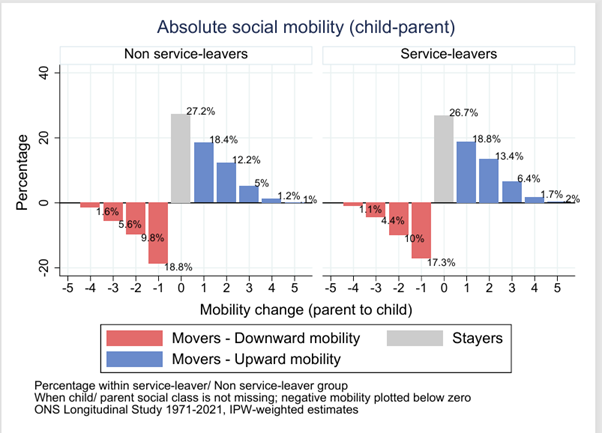
Figure: Absolute Intergenerational Social Mobility by Service‑Leaver (Veteran) Status. Source: ONS LS
Research impact
The research contributes to the evidence base on the long‑term socioeconomic outcomes of UK Armed Forces veterans. The wide variation in mobility amongst service leavers, particularly between regular and reserve service leaders showing opposing mobility is of relevance to the Armed Forces Covenant, which commits the government to ensuring that veterans are not disadvantaged relative to civilians. These findings could contribute to policies on veteran transition, reserve recruitment, and employer engagement.
The team is proactively engaging engaged with the Office for Veterans’ Affairs, Forces in Mind Trust, and veteran‑support organisations to discuss finings.
The work also supports the use of improved data on service history across government surveys and future census collections.
Research outputs
Key publications and reports
Published journal article 2024, https://doi.org/10.23889/ijpds.v10i4.3235
About the ONS Secure Research Service
The ONS Secure Research Service is an accredited trusted research environment that provides secure access to de‑identified, unpublished data. It operates under the Five Safes Framework to ensure safe people, safe projects, safe settings, safe data, and safe outputs.
If you use ONS Secure Research Service data and would like to discuss writing a future case study, please contact IDS.Impact@ons.gov.uk. Please also report any outputs here: Outputs Reporting Form.
Acknowledgement
This work contains statistical data from ONS which is Crown Copyright. The use of the ONS statistical data in this work does not imply the endorsement of the ONS in relation to the interpretation or analysis of the statistical data. This work uses research datasets which may not exactly reproduce National Statistics aggregates. The authors alone are responsible for the interpretation of the data.