
Annual Survey of Hours and Earnings linked to Census 2021 - England and Wales (coming soon)
This dataset links the Annual Survey of Hours and Earnings (ASHE) to Census 2021 for England and Wales. It has been developed as a collaboration between the Office for National Statistics (ONS) and the ADR UK-supported Wage and Employment Dynamics (WED) project.
The dataset is currently in development. It is expected to become available in summer 2026.
The Annual Survey of Hours and Earnings (ASHE), carried out in April each year, is the most comprehensive source of information on the structure and distribution of earnings in the UK. ASHE provides information about the levels, distribution and make-up of earnings and paid hours worked for employees in all industries and occupations.
The 2021 Census gives information on the characteristics of all the people in England and Wales and the households they occupy. The Census is undertaken every 10 years by the Office for National Statistics.
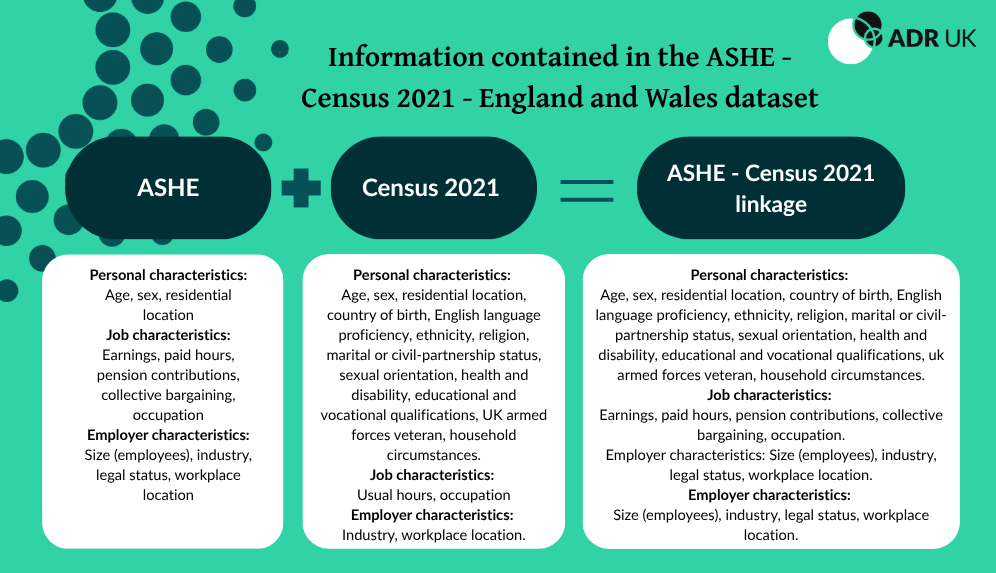
Linking these datasets allows for increased depth and breadth of research on the labour market. It extends the range of information available for ASHE sample members to include additional permanent characteristics (ethnicity, nationality, formal education), semi-permanent characteristics (disability, number and age of children, marital status) and transient characteristics (household composition).
Related datasets
ASHE has already been linked to the 2011 Census for England and Wales: find out more.
The linkage to the 2021 Census will provide more recent information on the characteristics of ASHE sample members. Once the ASHE – 2021 Census dataset is available, it will be possible to create a combined dataset in which a subset of ASHE sample members have linkages to both the 2011 and 2021 Censuses.
The WED team have developed other ASHE-linkages that may be of use alongside this data:
- ASHE linked to Migrant Workers Scan – England, Scotland and Wales
- ASHE linked to PAYE and Self-Assessment data – England, Scotland and Wales
The WED team have developed additional documentation for each dataset and a user forum to support researchers. They have also created code to enrich the core ASHE dataset by adding new variables (e.g. minimum wage rates and survey dates) and new weights which account for attrition and selection effects. This code is available within the Office for National Statistics (ONS) Secure Research Service and on the WED website. Please note that this code is not part of the ONS ASHE Official Statistics output.
ASHE is also being linked to the 2022 Census for Scotland and the 2021 Census for Northern Ireland. The linkage to the 2022 Census for Scotland is being led by Research Data Scotland; the linked data will be made available in the Scottish National Safe Haven. The linkage to the 2021 Census for Northern Ireland is being led by NISRA; the data will be made available in the NISRA Secure Environment.
Component datasets and linkage
The ASHE dataset includes de-identified personal information such as age, gender, employment information (such as wage and working hours), and employer information (such as employer size, industry sector and location). The Census 2021 dataset contains de-identified personal information such as demographics, family, household information, ethnicity, religion, location, education and language. Linkage of the two datasets has been undertaken by ONS. Users will benefit from some prior familiarity with the ASHE data.
| Timeframe | 1999-2022 (ASHE) and 2021 (Census 2021) |
|---|---|
| Update Frequency | Annual (ASHE) and one-off (Census 2021) |
| Population | ASHE population spine (approx. 0.66% of the entire workforce) |
| Coverage | England and Wales |
| Size | Approximately 150,000 jobs per year in ASHE. Linkage rate to 2021 Census to be confirmed (74% for 2011 Census). |
Examples of research questions
- How do people’s earnings change throughout their career? And how does this differ depending on characteristics such as gender, disability, or ethnicity?
- What are the patterns or characteristics of those who do and do not progress out of low paid employment?
- What is the relationship between migration and the labour market?
- What role do employers play in wage inequality?
- How do household characteristics shape earnings trajectories for different groups?
This list is illustrative only and intended to demonstrate the research potential of the dataset. For research priorities, see the Areas of Research Interest website.
Core documentation

User Guide
The beta user guide for this dataset is available on the WED website.
Please note that a comprehensive user guide is in development and will be finalised once data linkage has been completed. When the final version is completed, it will be made available on the WED website and on this page.
Contact wagedynamics@uwe.ac.uk for further information.

Data Dictionary
The beta data dictionary for this dataset is available on the WED website.
Please note that a comprehensive data dictionary is in development and will be finalised once data linkage has been completed. When the final version is completed, it will be made available on the WED website and on this page.
Contact wagedynamics@uwe.ac.uk for further information.
Other supporting resources
| Resource | Description |
Synthetic dataset | The beta synthetic dataset will be available on the WED website. It is purely illustrative at this stage and is intended only to provide an indication of the structure of the final dataset. It contains an illustrative selection of variables whose values have been generated at random; it does not seek to reproduce any of the moments from the data. When the final version is completed, it will be made available on the WED website and on this page. For clarifications and to provide feedback on the documentation please contact: wagedynamics@uwe.ac.uk. |
Data Explained (not yet published) | This Data Explained will summarise experiences and learning from working with the ASHE- Census 2021 linked dataset. |
Code to support ASHE-2021 Census (not yet published) | This code will support use of the data by linking the household Census tables to the individual records in the ASHE-Census 2021 linked dataset. The code will be made available in the ONS Secure Research Service (SRS) code repository. |
Training to use the data (not yet scheduled) | The WED team will host training sessions (in-person and online) to introduce users to the data. |
The Knowledge Hub is a community and knowledge base for researchers who are interested in or are currently accessing datasets curated by the WED team. The Knowledge Hub allows this growing community of researchers to access relevant information and engage with other WED data users. It is intended as a platform for researchers to ask questions of each other regarding WED datasets or analysis. It allows researchers to connect, collaborate and share knowledge, insight and good practice. |
Accessing the data
Once the ASHE linked to Census 2021 data is made available (expected summer 2026), accredited researchers will be able to request access in ONS Secure Research Service (SRS) projects.
More information about how to access the dataset will be available on this page. Find out more about how to access ADR UK data for research.
1. Apply to become an accredited researcher under the Digital Economy Act 2017
- Apply for researcher accreditation through the ONS People & Projects Service.
2. Apply for an accredited research project
- Submit an application to the Project Accreditation Service for the ONS SRS.
3. Access the data securely
The options that are expected to be available to access this dataset are:
- Assured Organisational Connectivity – the ability to access the ONS Secure Research Service from your office or home. Check what arrangements your institution already has or can put in place.
- SafePod Network– a small, self-contained secure room with a single workstation
- Safe Rooms – based in ONS offices in Titchfield and Newport, open Monday-Friday, 9.00-16.00
Please note that if an SRS project has access to other datasets then access may be more restrictive (e.g. not allowing home access).
Find out more
Keep up to date on the ASHE – Census 2021 dataset on the ADR UK website or sign up for updates. Or get in touch with the Wage & Employment Dynamics team directly via their website.
